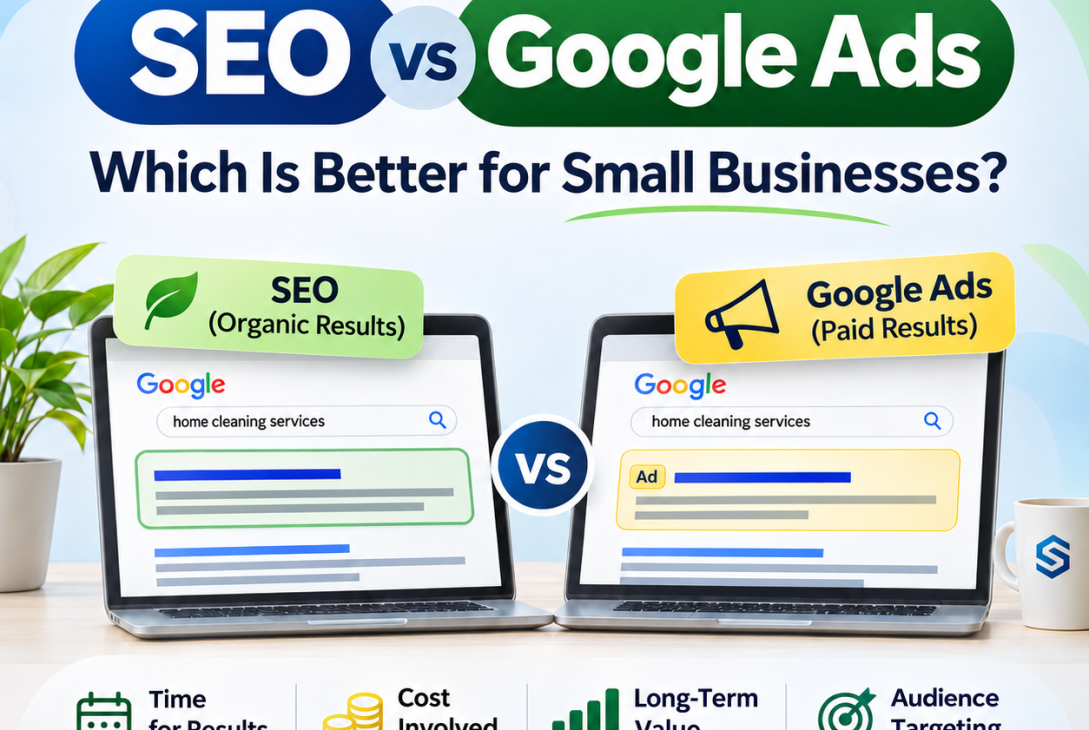
Many small businesses want more customers from Google. But when they start online marketing, one common question comes up: Should they invest in SEO or Google Ads?
Both can help people find your business online. However, they work in different ways and require different types of investment. Before deciding, explore SEO services at SwiftMaze Tech to understand how organic search improvements can support your business.
SEO helps improve your website’s visibility in unpaid search results. Google Ads allows businesses to pay for advertising opportunities in Google Search and other supported places.
SEO may be useful for building search visibility over time. Google Ads can help you reach people through paid campaigns when your ads are eligible to appear.
But neither option guarantees customers or sales.
In this guide, we explain SEO vs Google Ads in simple language. You will learn about their costs, benefits, limitations, and how to choose the right approach for your small business. For related advice, read our guide on whether small businesses need a website or social media alone is enough.
What Is SEO?
SEO stands for Search Engine Optimization.
It means improving your website so search engines can better understand your content and people can find useful information about your business.
For example, imagine someone searching Google for home cleaning services in Ahmedabad.
A cleaning company may create a helpful page explaining its services, locations, booking process, and contact details.
Google may show that page in its unpaid search results if it finds the page useful and relevant to the search.
This type of visibility is called organic search visibility.
However, publishing a page does not guarantee that Google will rank it or display it for every related search.
What Does SEO Include?
SEO covers several important activities:
- Keyword Research: Understanding what potential customers search for.
- Helpful Content: Creating pages that answer real customer questions.
- Page Titles and Headings: Making page topics clear.
- Website Structure: Helping visitors and search engines find important pages.
- Technical Improvements: Fixing problems that make website pages difficult to access.
- Local Business Information: Keeping relevant business details accurate.
- Internal Linking: Connecting useful pages within the website.
For a practical explanation of these activities, visit the Google SEO Starter Guide.
What Is Google Ads?
Google Ads is an advertising platform that allows businesses to promote products and services through paid campaigns.
For example, a business offering pest control services may create a Search ad for people looking for pest control in its service area.
If the campaign meets Google’s requirements and wins a suitable advertising opportunity, the ad may appear when someone searches for a related term.
Google Ads supports different campaign types. In this guide, we mainly compare SEO with Google Search ads, because both can help businesses reach people searching on Google.
How Do Google Search Ads Work?
A business chooses a campaign goal, budget, relevant keywords, and other settings.
Google considers several factors when deciding whether to show an ad. These can include the bid, the quality of the ad, the landing page, and the context of the search.
A landing page is the page someone opens after clicking an advertisement.
Many Search campaigns use a payment method called cost per click, or CPC. This means the advertiser pays when someone clicks the ad.
Not every Google Ads campaign uses exactly the same payment method.
You can learn more from Google’s official guide to online advertising.
SEO vs Google Ads: What Are the Main Differences?
Both methods can help customers discover your business, but they work differently.
1. Organic Visibility vs Paid Advertising
With SEO, businesses work to improve their visibility in Google’s unpaid results.
There is no fee to Google for each click on an organic search result.
However, SEO is not completely free. Creating content, improving a website, and maintaining search visibility still require time, knowledge, or money.
With Google Ads, businesses pay for advertising according to the campaign’s pricing method.
For example, a business may set a budget to reach people searching for a specific service.
Paying for ads does not improve the website’s organic ranking. Google keeps paid advertising and organic search ranking separate.
2. Time Needed to See Results
Google Ads campaigns may start showing eligible ads after setup and approval.
This can make paid advertising useful for a new business, a special offer, or a service that needs attention soon.
However, getting clicks does not mean the business will immediately receive useful enquiries.
SEO usually takes longer to develop.
Google needs to discover, understand, and evaluate website pages. Search results can also change over time.
Some improvements may become visible sooner than others, but there is no fixed SEO timeline that applies to every website.
3. Marketing Costs
SEO costs depend on the work required.
A small website may need basic improvements to page titles, business information, and content.
A larger website may need ongoing technical work, content updates, and regular reviews.
Google Ads costs depend on the campaign budget, competition, keywords, and other advertising factors.
A competitive keyword may cost more per click than a less competitive keyword.
Businesses should compare the total cost of both options rather than assuming one is always cheaper.
4. What Happens When You Stop Spending?
If you stop a paid Search campaign, its ads normally stop appearing, so that campaign no longer brings paid clicks.
SEO works differently.
A useful website page may continue receiving organic visits after active optimization work slows down.
However, SEO visibility is not permanent or guaranteed.
Competition, outdated content, technical issues, and search changes can affect rankings.
Both approaches need regular review to remain useful.
5. Control Over Audience and Location
Google Ads provides settings for targeting selected locations, languages, and audiences, depending on the campaign.
For example, a service company may want to advertise in Ahmedabad and nearby cities.
SEO can also help businesses create content for relevant locations and services.
However, organic results are selected by search engines rather than directly controlled through advertising settings.
Neither method guarantees that every visitor will be a potential customer.
Is SEO Better for Long-Term Business Growth?
SEO can be useful when customers regularly search for the products or services your business offers.
For example, a company providing website development may publish detailed service pages and helpful articles about choosing a business website.
These pages can answer questions from people who are researching their options.
Good SEO also encourages businesses to improve their website content, structure, and usability.
For example, a page explaining a service clearly may help visitors understand what the business provides before contacting it.
Businesses interested in improving search visibility can explore SEO services at SwiftMaze Tech for information about keyword planning, website improvements, and content optimization.
When SEO May Be a Good Choice
- Your products or services have regular search demand.
- You can invest time in improving website content.
- You want to make your website more useful for customers.
- You have a long-term marketing plan.
- You can maintain your website and update important information.
SEO may be less suitable as the only marketing activity when a business needs enquiries very quickly and has little existing search visibility.
When Should Small Businesses Choose Google Ads?
Google Ads may be useful when a business wants to reach people searching for its products or services through paid campaigns.
For example, a new home repair service may use Search ads to reach people looking for repairs in a selected area.
A business may also use Google Ads to test whether customers are interested in a new service.
When Google Ads May Be a Good Choice
- You want to promote a new service.
- You have a defined advertising budget.
- You want to test demand for a product or service.
- You need to target selected service areas.
- You have a useful page where visitors can request information.
- You can track advertising results and improve campaigns.
One important point is that Google Ads requires ongoing budget management.
Businesses should also review the quality of the enquiries, not just the number of ad clicks.
To understand how paid campaigns are planned, explore Google Ads management services at SwiftMaze Tech.
How Much Should a Small Business Spend on SEO or Google Ads?
There is no single marketing budget that works for every business.
The amount you spend should depend on your goals, available funds, industry, competition, and the value of a customer.
Start by asking how much a new customer is worth to your business.
For example, a company that earns a small amount from each order may need a different marketing plan from a business selling higher-value services.
A Simple Google Ads Cost Example
Imagine a business starts with an average daily advertising budget of Rs. 300.
Using 30 days as a simple planning estimate, the business may plan for approximately Rs. 9,000 in advertising spend.
This is only an illustration. It is not a recommended minimum budget or a quotation.
Google Ads uses its own budget and billing rules, so actual daily spending can vary.
For example, Google’s standard average daily budget calculation uses about 30.4 days for a monthly period, subject to the applicable campaign rules.
The business may also need to account for agency fees, website changes, tracking tools, and applicable taxes.
Before investing, estimate how many valuable enquiries or sales the business would need to make the spending worthwhile.
What About SEO Costs?
SEO work does not have a universal monthly price.
Costs depend on the website’s current condition, the number of pages, competition, content needs, and the work required.
A business owner may complete some basic tasks independently.
Other tasks may require help from a designer, writer, or SEO specialist.
Do not compare a monthly SEO service fee with only the Google Ads budget. Compare the complete cost of each activity.
Can SEO and Google Ads Work Together?
Yes. For many businesses, using both can make sense when the budget allows it.
SEO and Google Ads can support different stages of a marketing plan.
For example, a new training institute may use Search ads to promote upcoming course admissions.
At the same time, it may create helpful website pages explaining available courses, fees, requirements, and frequently asked questions.
The advertising campaign can support short-term visibility while useful website content develops over time.
However, using both is not automatically the best decision for every small business.
If your marketing budget is very limited, it may be better to focus on one clear goal first.
How to Decide Where to Start
Begin by reviewing these questions:
- Do you need enquiries soon, or are you planning for the future?
- Does your website clearly explain your services?
- Are people already searching for your products or services?
- How much can you spend without putting pressure on the business?
- Can you measure calls, forms, sales, or other useful results?
- Will you have time to maintain the selected marketing activity?
Your answers can help you decide whether to begin with SEO, paid advertising, or a small combination of both.
Why Does Your Website Matter for Both SEO and Google Ads?
A website plays an important role in both methods.
For SEO, helpful pages can improve how clearly search engines and visitors understand your business.
For Google Ads, a useful landing page can help people find the information promised in the advertisement.
For example, an advertisement about office cleaning should lead to a page that clearly explains the office cleaning service.
Sending every visitor to a general homepage may not always be the best experience.
A useful business website should have clear service information, easy navigation, working contact forms, and readable content on mobile devices.
If you are unsure whether your business needs a website, read our guide on whether small businesses need a website or social media alone is enough.
How Can You Measure SEO and Google Ads Results?
Marketing performance should be measured using results that matter to your business.
Website visits and ad clicks can provide useful information, but they are not the same as sales.
Useful SEO Measurements
- Visits from unpaid search results.
- Search terms bringing visitors to your website.
- Important pages appearing in search.
- Customer enquiries from organic traffic.
- Technical problems affecting website access.
Google Search Console can help website owners understand their search visibility and identify some technical problems.
Useful Google Ads Measurements
- Advertising spend.
- Number of clicks.
- Cost per click.
- Phone calls or form submissions linked to ads.
- Cost per useful enquiry.
- Sales or bookings linked to advertising.
Tracking needs to be configured correctly before these measurements can be trusted.
For example, a form submission should not automatically be treated as a confirmed sale.
Common Mistakes Small Businesses Should Avoid
Expecting Immediate SEO Rankings
SEO is not a guaranteed way to reach the first page of Google.
It requires useful content, technical care, and patience.
Running Ads Without a Clear Goal
Businesses should know what they want visitors to do after clicking an advertisement.
For example, the goal may be to request a quote, book an appointment, or purchase a product.
Targeting Too Many Unrelated Keywords
Not every search is relevant to your business.
Choose keywords that match what you actually offer and what customers are looking for.
Ignoring Website Problems
Slow pages, unclear services, and broken enquiry forms can create problems for visitors from both paid and unpaid search.
Judging Success Only by Traffic
More visitors do not always mean more customers.
Review whether the traffic is relevant and whether people are taking useful actions.
What About AI Search and Google AI Overviews?
Search experiences continue to change as Google introduces AI-powered features.
Businesses may wonder whether SEO still matters when people use AI Overviews or AI Mode.
Google’s guidance explains that normal SEO practices remain important for these search experiences.
Helpful content, clear business information, accessible pages, and accurate answers can support how search systems understand a website.
There is no guaranteed method that makes a business appear in AI-generated search results.
Paid advertising also does not buy better organic rankings.
For more details, see Google’s guidance about AI features and websites.
Frequently Asked Questions
Is SEO Better Than Google Ads?
Neither option is always better. SEO may support long-term search visibility, while Google Ads can help businesses reach selected searches through paid advertising. The right choice depends on your business goals and budget.
Is SEO Free?
Google does not charge for clicks on unpaid organic search results. However, SEO work may involve costs for content, technical improvements, and ongoing website management.
Can Google Ads Improve My SEO Ranking?
No. Google states that paying for ads does not improve your website’s position in organic search results.
Can Small Businesses Start Google Ads With a Small Budget?
Yes, businesses can set advertising budgets. However, a small budget may limit reach, especially when competition and click costs are high. There is no guaranteed number of enquiries.
How Long Does SEO Take?
There is no fixed timeline. Some website improvements may be noticed sooner than others, while meaningful search visibility can take longer. Competition, content quality, and website condition all matter.
Should a New Business Choose SEO or Google Ads First?
A new business should first review its goals, website, available budget, and customer demand. Google Ads may help test short-term demand, while SEO can help build a useful website for future searches.
Can I Use SEO and Google Ads Together?
Yes. They can support different marketing goals, but businesses should only use both when they have the budget and time to manage them properly.
Final Thoughts
SEO and Google Ads can both help small businesses connect with people searching online.
SEO focuses on improving visibility in unpaid search results. Google Ads helps businesses reach selected audiences through paid advertising.
The right approach depends on your business goals, competition, budget, website quality, and the time available to achieve results.
Before spending money, make sure customers can clearly understand what your business offers and how to contact you.
If you want help comparing digital marketing options for your business, you can contact SwiftMaze Tech to discuss your requirements.
For more useful articles about websites, software, and marketing, visit the SwiftMaze Tech Blog.
Sources and Further Reading
- Google Search Central: SEO Starter Guide
- Google Search Central: Do You Need an SEO?
- Google Ads Help: Using Google Ads for Online Marketing
- Google Ads Help: Paid and Organic Search Results
- Google Search Central: AI Features and Your Website
Last modified: November 10, 2026