
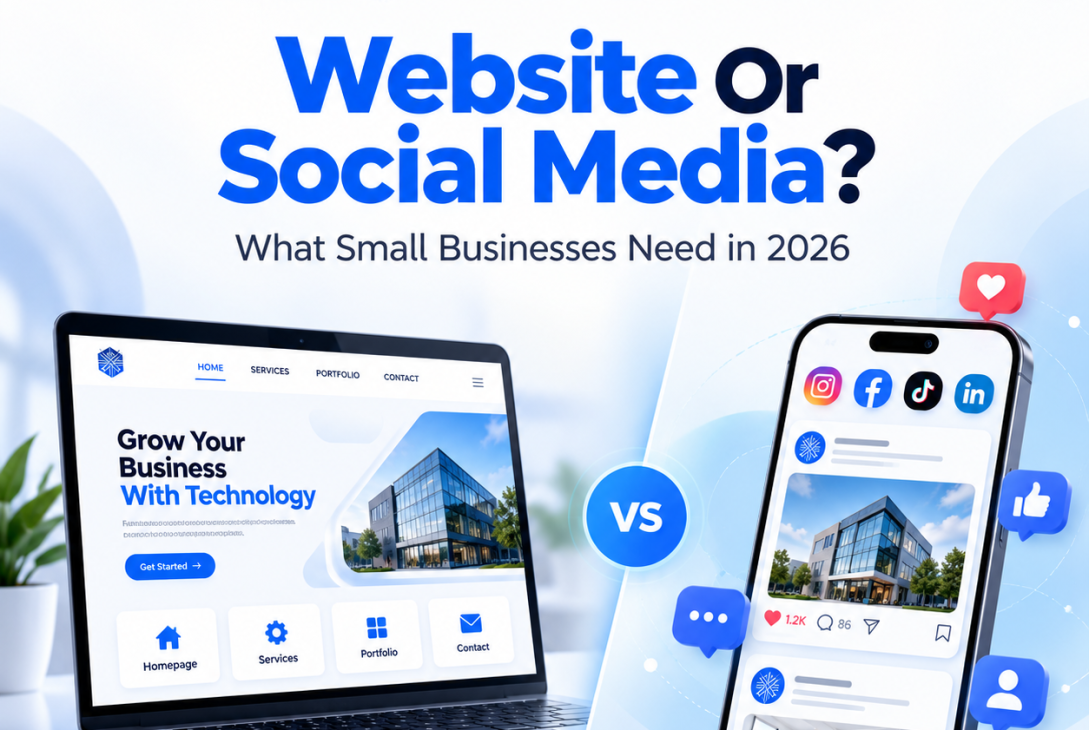
Many small businesses use Instagram, Facebook, and WhatsApp to connect with customers. They share product photos, answer questions, and receive orders through these platforms.
So, do small businesses still need a website in 2026?
The answer depends on the business. Social media can be enough for some small businesses, especially when they are just starting. But a website can become useful when customers need more information, search for services on Google, or want a simple way to contact the company.
A website and social media are not replacements for each other. They serve different purposes. Social media helps people discover and follow a business. A website can help them understand the business, explore its services, and take the next step.
In this guide, we explain the differences, benefits, costs, and practical situations in which a business website makes sense.
Do Small Businesses Really Need a Website in 2026?
Not every small business needs a website from its first day. However, many businesses can benefit from having one as they grow.
Think about what happens when a customer hears about a company for the first time.
They may search for its name on Google, check its social media profile, look for reviews, and compare services before contacting it.
If the company has a website, the customer can find important information in one place.
For example, a website development company can explain its services, show past projects, answer common questions, and provide a contact form.
A clothing store may use its website to display products, sizes, delivery policies, and ordering information.
The website does not need to be large or expensive. Its main purpose should be to help customers complete useful tasks.
What Can Instagram and Facebook Do for a Business?
Social media platforms are useful tools for reaching people and staying connected with customers.
Businesses use Instagram and Facebook to share product photos, videos, offers, updates, and customer experiences.
Benefits of Social Media for Small Businesses
- Easy to Start: Creating a basic business profile does not require building a separate website.
- Direct Communication: Customers can ask questions through comments and messages.
- Regular Updates: Businesses can quickly share new products, announcements, and offers.
- Community Engagement: Customers can follow, comment, share posts, and interact with a brand.
- Advertising Options: Businesses can run paid campaigns to reach selected audiences.
For example, a small fashion boutique may use Instagram to show new clothing collections and receive enquiries through direct messages.
If this process works well, the boutique may not need a full ecommerce website immediately.
Businesses that want to improve their online presence can also explore social media marketing services to understand how content planning and audience engagement work.
However, relying only on social media also creates some limitations.
What Are the Limitations of Using Only Social Media?
Social media profiles operate on platforms owned by other companies.
Businesses must follow the platform’s rules, available features, and account policies.
Limited Control Over Your Business Page
On social media, businesses cannot fully control how their content is displayed or which followers see every post.
Platform changes may also affect available features and content reach.
A business website gives you more control over its layout, pages, content, and customer journey, although hosting and maintenance still depend on the services you use.
Important Information Can Be Hard to Find
Imagine a customer looking for the price, service area, warranty details, and contact information of a repair company.
If these details are spread across different social posts, the customer may need to search for them or send a message.
A website can organize this information into clear pages that are easier to find.
Limited Custom Features
Social media is useful for communication, but businesses may need features that do not fit inside a standard social profile.
These may include detailed enquiry forms, appointment booking, product filters, customer accounts, or custom order workflows.
A suitable website can provide these features when they are needed.
Website vs Social Media: What Is the Difference?
The biggest difference is how customers use each platform.
Social media is often useful for discovering businesses and following updates. Websites can provide organized information and support actions such as booking, requesting a quote, or making a purchase.
Business Information
Social media profiles can display important business details, but space and layout options are limited.
A website can provide dedicated pages for services, products, company information, frequently asked questions, and contact details.
Search Engine Visibility
Public social media pages may appear in search results. However, a website allows businesses to create dedicated pages that target specific customer questions and services.
For example, a cleaning company can create separate pages for home cleaning, office cleaning, and its service areas.
These pages may help search engines understand the business and match relevant searches.
However, creating a website does not guarantee Google rankings or visitors.
Customer Enquiries
Social media supports direct messages and other contact options.
A website can also offer contact forms, clickable phone numbers, email links, and booking options.
Businesses can choose the enquiry method that makes the most sense for their customers.
Content Organization
Social media posts are normally displayed in feeds.
A website can organize information into menus, categories, service pages, and guides.
This helps customers who want to research a business before contacting it.
How Can a Website Help Customers Find Your Business on Google?
Search Engine Optimization, also called SEO, helps search engines understand website pages.
For example, imagine someone searching for website development services in their city.
A company with a clear service page, useful content, accurate business information, and a technically accessible website may have an opportunity to appear in relevant search results.
Google recommends using descriptive page titles, helpful content, understandable URLs, and links that search engines can follow.
According to the Google SEO Starter Guide, a website should be easy for both people and search engines to understand.
Useful SEO practices include:
- Creating clear service and product pages.
- Writing content that answers customer questions.
- Using meaningful headings and page titles.
- Making the website work properly on mobile devices.
- Adding relevant internal links.
- Keeping business contact details accurate.
- Making important pages accessible to search engines.
Businesses that want to learn more about search visibility can explore SwiftMaze Tech’s SEO services and the techniques used to improve website structure and content.
SEO is a long-term process. A new website may take time to build search visibility, and results depend on many factors.
Can a Website Help Your Business Appear in AI Search?
People are also using AI-powered search experiences to ask questions and compare products or services.
Google AI Overviews and AI Mode can show useful information and links from websites.
A business website can provide clear information about its services, location, products, policies, and expertise.
Google’s official guidance explains that normal SEO best practices remain important for AI search features.
There is no special AI file or guaranteed trick that makes a website appear in AI search results.
To improve your website’s usefulness, publish accurate information, answer real questions, and make important pages easy for search engines to access.
You can learn more from Google’s official AI Search guidance.
Which Small Businesses Can Benefit From a Website?
Different businesses need different types of websites. Here are some practical examples.
Local Service Providers
Electricians, repair companies, cleaning services, and other local providers can use websites to explain their services, working areas, and contact details.
A clear service page may help customers understand what the company offers before making a call.
Manufacturers and Suppliers
Manufacturers may need to show product specifications, business details, available categories, and enquiry options.
A website can also help buyers find documents and product information without requesting the same details repeatedly.
Coaching Institutes and Training Centers
Institutes can publish course details, schedules, admission requirements, fees where appropriate, and enquiry forms.
Students and parents can review the information before contacting the institute.
Professional Service Businesses
Consultants, designers, accountants, and software companies may use websites to explain their experience, services, process, and previous work.
Real project examples can help potential customers decide whether the company fits their needs.
Retail and Ecommerce Businesses
Retail stores can begin with a simple information website or product catalog.
When the business needs online orders, payments, shipping rules, and inventory management, an ecommerce website may become useful.
The right setup depends on the number of products, order process, and budget.
When Is Social Media Alone Enough?
Building a website is not always the first priority for a new business.
Social media alone may be enough when:
- You are testing a new business idea.
- You have only a few products or services.
- Customers already receive enough information through your existing channels.
- You can manage enquiries and orders without difficulty.
- You are still deciding what your long-term business model will be.
For example, someone selling handmade products to a small local audience may begin with an Instagram profile and direct messages.
Spending money on a large ecommerce website before confirming demand may not be the best decision.
As the business grows, a website can become more useful.
How Do You Know When It Is Time to Build a Website?
Instead of following a trend, look for real problems in your current business process.
Consider building a website if:
- Customers repeatedly ask for the same service or product details.
- You want to display a complete portfolio or product catalog.
- Potential customers search for your services on Google.
- You need a clear online place to explain your business.
- You want to collect enquiries through a structured form.
- You need booking, ordering, or other custom features.
- Your social media pages cannot organize important information properly.
These signs do not mean that your business needs an expensive website.
A small website with useful information may be enough.
How Much Does a Small Business Website Cost?
Website costs vary based on what the business needs.
A simple information website is usually less complex than an online store or a custom software platform.
Important cost factors include:
- Number of pages and content requirements.
- Custom design and branding.
- Contact forms and other features.
- Ecommerce or payment integrations.
- Domain and hosting services.
- Website maintenance and security.
- Additional integrations or custom development.
Businesses should also ask about ongoing expenses rather than comparing only the initial development price.
For example, domain renewal, hosting, software subscriptions, and maintenance may involve recurring costs.
Before choosing a website developer, request a clear description of what is included in the quoted price.
It is better to begin with a website that serves customers well than to spend money on features your business does not need.
What Should a Basic Small Business Website Include?
A good website does not need complicated features to be useful.
For many small businesses, these elements provide a practical starting point:
- Homepage: Clearly explain what your business offers.
- About Section: Share genuine information about your business.
- Service or Product Pages: Explain what customers can expect.
- Contact Details: Make it easy to call, email, or submit an enquiry.
- Mobile-Friendly Design: Make the website easy to use on phones.
- Basic SEO: Use helpful content, clear headings, and descriptive titles.
- Security: Use HTTPS and maintain the website responsibly.
Additional pages, such as portfolios, FAQs, pricing information, and customer reviews, can be added when they help visitors.
Always use genuine reviews and accurate business information.
If you are exploring different website options, you can learn about professional web development services, including business websites, ecommerce solutions, landing pages, and custom web applications.
Should You Use Both a Website and Social Media?
For many growing businesses, using both is a practical approach.
Social media can help people discover the business, see updates, and interact with the brand.
A website can provide detailed information and help visitors make decisions.
For example, a business may share a project photo on Instagram. Interested visitors can then open its website to explore the full project, learn about its services, and request a quotation.
This creates a more complete customer journey.
Businesses should not expect either channel to produce results automatically. Both need clear information, regular attention, and a useful customer experience.
Frequently Asked Questions
Can I Run a Small Business Without a Website?
Yes. Many businesses start with social media, referrals, marketplaces, or direct customer contacts. A website becomes more useful when customers need detailed information or your business needs additional online features.
Is Instagram Enough for a Small Business?
Instagram may be enough for some businesses, especially during the early stages. However, a website can help organize detailed information, support Google search visibility, and provide additional customer actions.
Does a Website Guarantee More Customers?
No. A website does not guarantee traffic, enquiries, or sales. Its results depend on the business, customer demand, website quality, marketing, and competition.
Is a One-Page Website Enough for a Small Business?
Sometimes. A one-page website may work well when the business has a small number of services and needs a simple online presence. More pages may be useful when customers need detailed information.
Do Small Businesses Need SEO?
Basic SEO can help search engines understand website content and may improve relevant search visibility. However, SEO results take ongoing work and are not guaranteed.
Can Social Media and a Website Work Together?
Yes. Social media can support discovery and engagement, while a website can provide organized information, contact forms, booking options, and other useful features.
Final Thoughts
So, do small businesses need a website in 2026?
For many growing businesses, a website can be a valuable part of their online presence. But it is not necessary for every business from day one.
Social media is useful for reaching people, sharing updates, and communicating with customers. A website can provide more control over business information, detailed service pages, and clear ways for customers to take action.
The best choice depends on your business goals, customers, budget, and daily needs.
Start with what your customers actually need. Build a simple website when it helps solve a real problem, and expand it as your business grows.
If you are planning a new business website or improving an existing one, you can contact SwiftMaze Tech to discuss your requirements.
For more helpful articles about websites, digital marketing, and technology, visit the SwiftMaze Tech Blog.
Sources and Further Reading
- Google Search Central: SEO Starter Guide
- Google Search Central: AI Features and Your Website
- Google Search Central: Creating Helpful, Reliable Content
- Squarespace: Do You Really Need a Website?
Last modified: November 3, 2026