Let’s start with a simple question: ‘Is present-day artificial intelligence the same as it was a couple of years ago?’
The answer is a definite no. AI has advanced by leaps and bounds, evolving from an emerging technological advancement into a mainstream force driving transformation globally. From the breakthrough of the widespread ChatGPT adoption in 2022 to Google’s AI assistant Gemini, the power of generative AI has been revolutionary.
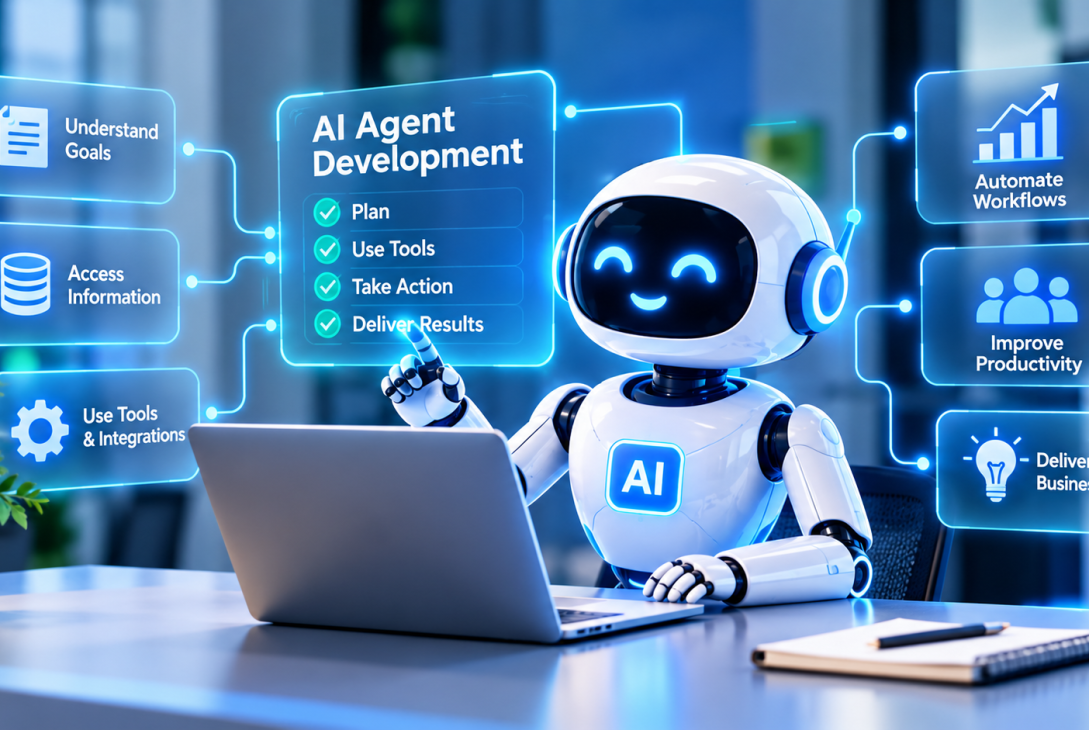
Artificial intelligence has gone far beyond simply answering questions or helping with data classification. Businesses that are using AI are looking for AI agent development services to design software that can automate the understanding of goals, information access, use of connected tools, and offer measurable value while adhering to compliance standards.
An AI agent is not any other conversational interface like a typical chatbot. AI agents don’t wait for a prompt to respond; they work towards a defined outcome by extracting relevant data from approved sources and executing autonomous actions within the defined access controls. This ability of AI agents to plan and act independently across multiple steps is what makes them a valuable addition to complex business workflows.
Let’s understand AI agent development in a little detail.
What is AI Agent Development?
AI agent development refers to the process of designing, developing, deploying, testing, and maintaining AI-powered systems. Instead of relying on fixed and predefined rules, these agents can reason, retrieve data, and connect tools independently. This doesn’t mean that AI agents operate without boundaries or that they are replacing human agents. Based on the set permission controls and evaluation of the current context, the AI agents respond within the restricted set of actions.
Let’s understand this better with the example of a customer support agent.
If a customer is looking for an update regarding their order status, a traditional chatbot would simply respond, ‘Your order is delayed’. An AI agent gives further details by checking the order management system, identifying the reason for the delay, confirming the available options, and then summarizing the final response for the customer.
For a practical customer communication example, you can also read SwiftMaze Tech’s guide on managing WhatsApp customer conversations with a shared team inbox, where team conversations, lead tracking, and follow-ups are managed through a more organized workflow.
Why is the Investment in AI Agents Shooting Up?
A growing number of businesses are scaling their investment in AI agent development to gain substantial ROI from automation tools. These tools are useful, but they operate on defined triggers and rules. In the evolving business environment, a one-size-fits-all approach no longer exists.
These automation tools work on fixed logic, which is why they can’t adapt their responses to the specific situation or if the prompt is outside their predefined rules. Therefore, AI agents are better suited because they take the right action based on the current context of the situation. They compare the information, interpret the unstructured data, choose from the available tools, and then alter the approach if required. In scenarios that involve repetitive tasks with multiple systems and constantly changing inputs, these AI agents can deliver substantial ROI.
Some of the top-rated benefits of AI agent development include:
- Improving the customer experience and employee productivity
- Less manual effort as repetitive tasks are automated by AI agents
- AI agents provide consistent development
- Knowledge spread across multiple files, systems, and platforms can be put to better use
For another simple business automation example, see SwiftMaze Tech’s guide on using WhatsApp chatbot buttons for lead capture.
Core Components of an AI Agent
Successful AI agent development demands a lot more than simply choosing the appropriate large language model. An AI agent is a system that is a cumulative mix of distinct connected parts, with each one having a specific role to perform and a contribution to make.
Reasoning Engine
The reasoning engine is used for interpreting the AI agent’s goal, assessing and extracting the available business information, and deciding the next step of action. In most modern systems, an LLM performs this role by choosing the next best step based on an evaluation of the current task and permitted actions. Reasoning is often used by a well-defined agent where flexibility is needed.
Goal and Instructions
Each AI agent needs a precise and defined objective, because vague instructions can result in inconsistent and irrelevant results. Clear instructions help to define what the AI agent is supposed to do, what it can’t do, and when it needs to stop. The agent’s tone, decision-making power, and escalation process are also defined.
Tools and Integrations
AI agents alone can’t add any value; they need to interact with existing tools and business systems. Based on the use case, these tools can be ERP and CRM platforms, search systems, databases, calendars, payment systems, inventory tools, internal APIs, and so on. The agent’s access needs to be limited only to the level needed for performing the assigned job.
Knowledge and Memory
The performance of an AI agent relies on access to reliable, current, and updated information. This can include policy documents, product documentation, knowledge base, support articles, and approved business records from connected systems.
Memory helps maintain and improve continuity. Short-term memory helps an AI agent ensure consistency during a single task, whereas long-term memory helps store approved preferences and prior interaction records.
A Step-by-Step Approach to AI Agent Development
The biggest mistake most companies make is starting AI agent development with technology instead of business goals and workflows. Effective AI agents can be developed when the objective is clear-headed, the process is well-defined, and seamless integration and implementation is ensured with the right technology.
Businesses that want to move from planning to real implementation can also explore AutomizeHub’s AI agent and workflow automation services for custom AI systems, business process automation, integrations, and AI-powered workflows.
Here’s a step-by-step development approach that can help your business monetize the value from AI agents:
1. Begin with a High-Value Workflow
Narrow down the bigger picture into a single business problem that needs to be addressed with a clear owner and measurable metrics. Some of the good starting points for AI agent development include lead qualification, employee onboarding, following up on an invoice, preparing for a meeting, and so on.
Always choose to build an AI agent for a specific task with a well-defined workflow that has clear requirements, performance measures, and risk control policies. To identify a high-value workflow, you can ask questions like:
- Which actions should the agent be permitted to take?
- What decisions require human approval?
- Which tasks are currently slow or prone to errors?
- How will success be measured?
2. State the Agent Scope
This is the step of defining the purpose and role of the AI agent in the business workflow. An AI agent with a well-defined scope reduces the possibility of confusion by specifying these details:
- agent purpose
- available data sources
- end user
- availability of tools
- exclusions
- expected outcome
3. Identify Reliable Data Sources
The reliability of an AI agent depends on the reliability and quality of data it can access. Therefore, make sure the documents and databases are free of bias or errors and updated before being used by the AI agents. Review them thoroughly for accuracy, duplication, outdated details, and access controls.
You don’t want to connect the AI agent to conflicting information, as it can result in inconsistent recommendations.
4. Connect Approved Tools
If you don’t want your AI agent to be an information assistant alone, you need to ensure the quality and availability of tools to convert them into action-oriented systems. Begin with a limited number of integrations that support the workflow and have validation checks as a key parameter of each integration.
5. Evaluate and Test
Testing the AI agent before full-scale launch is essential to measure its value addition. Test the agent with more than one situation and example by evaluating details like:
- Incomplete or inconsistent information
- Conflicting data
- Unauthorized requests
- Routine requests
- Tool failures
- Override attempts
The objective is simple: identifying where the AI agent performs well, where it fails, and if the failures are manageable.
6. Launch and Monitor
Begin with a phased rollout and then gradually proceed with full deployment once the AI agent performs well with a small group of customers. In this, you must evaluate the performance, gather feedback, ensure data and approval access, and improvise the instructions if needed.
Suggestion:
If your AI agent development process is in its early stage, it might also be beneficial to use human-in-the-loop review. This helps identify errors early on before they affect a larger group of users.
The Future of AI Agent Development
AI agents have been and will continue to be a significant part of everyday business operations and software. Replace the conventional method of switching between multiple dashboards and applications with an AI agent that seamlessly works with the approved systems to deliver a clear and expected outcome.
If you want to retain long-term value of AI agent development, you must not only prioritize autonomy but also focus on transparent design, high-quality data, and measurable outcomes. Don’t hesitate to begin with your AI agent development idea because you are unsure if an AI agent can complete every task on its own. Don’t look to replace humans in the process but focus on how an AI agent can ensure reliable, secure, and useful task completion while leaving more time for the team to focus on creativity, strategy, and accountability.
Last modified: November 3, 2026